Tuesday, September 6, 2016

Losing Amma


I do not know why I am thinking about this now...

It was a narrow, sharp bend. A blind curve where you wouldn’t see the vehicle until they were right on your face. But vehicles were at a premium that day after a local party had called a strike. Amma was catching my hand (or was it the other way around?) as we crossed the road. Opposite side of the road was the SBT Munnar branch, our temporary abode till we could find ourselves a jeep to take us around the town.

When we reached the middle of the road an auto-rickshaw sprang out of the curve at great speed. I jumped back a couple of steps to where I was standing to avoid the on-coming auto. 

The next thing I remember is seeing my mom standing there in the middle of the road, her newly-bought rain sandals, stuck under the auto's front wheel. Thankfully, the auto driver had applied brakes right in time to avoid an accident.

She looked at me and asked, "Why did you leave me there like that?"


I do not know why I am thinking about this now. But it's a recurring thought – something that has bothered me at odd hours throughout my life. Back in school, when the incident had happened, it had affected me so badly. I had, at least according to the naive minds of a third standard student, performed the unforgivable sin – give up on my mother.

"Heightened odepial years", my girl friend remarked, when I explained to her on a casual afternoon in bed some years back. She went on to explain how young men often thought of their mothers while they were with their partners and it was nothing unique. I did not want to disagree with a psychology graduate, though at that time, the idea had completely disgusted me. There was certainly an explanation beyond a 'sexual desire for his mother' to what had happened that day. 

It happened again on an Onam day few years later. I had changed cities and was trying to make new friends in Bangalore.

"Mallu?" she asked.

"Yes, hence the mundu," I replied.

"One of those Mumma's boys?" she was persistant.

And suddenly, just like that, I thought about the incident in Munnar again. There was my mother looking at me and asking why I had left her.

"Hahaha, how predictable have we lot become," I remarked. But my mind had already logged out of the conversation. It had gone back to contemplating why I had left my mom there on the road. I had seen the auto... I could have pulled her back with me... Or I could have stayed with her... Why did I choose to do what I did?

"What does it all mean though," I asked myself, while looking at the candle melt slowly in front of me. Did it signify something? Why was the incident so alive in my mind? Like it had happened only an hour ago. Why was it that every time I thought about the Munnar accident, I got this feeling that it happened very recently? Why was it never an event of the past? Why was I living it?

Have I let her down somehow? Have I constantly been letting her down? Was that why the image of my mother always remained contextual? But how and why? Did she not know that I chose to stay in India because I wanted to be there when the family needed me. Surely she did. Did she not approve my decision to stay alone, away from marriage and family and everything fundamentally ‘normal’?

Or was I missing the whole point?

She simply looked at me and asked, "Why did you leave me like that?"

But strangely there was a sense of calmness on her face. She wasn't angry. She did seem let down, yes. But it looked like she was shocked. She was startled this had happened. That I had let go off her hands to have my own way. She gave a nod. But it was to herself. An acceptance of sorts. She took the sandals in her hand, crossed the road, and from the other side, looked at me.

There was certainly more to this. 

Why had I not recollected the entire sequence ever before? Suddenly I was devoured by an overwhelming desire to be with my ex-girl friend. I missed her subtle ways of explaining things with psychology, although it never made sense to me. Was my mind re-playing this image of mom, this incident, which probably had no meaning as a stand-alone event, as a signifier to a lesson that was taught to me by her? A lesson she continued to stress upon while my brother and I were growing up?

I was suddenly bombarded by a torrent of visions...

My father hits my mother while she stands next to the bed, her hair untied. My brother and I watch, our excessive anger canned up by an unparalleled fear.

We are in the kitchen now, slightly grown up. My mother is holding a knife, pleading my father to end her life.

Suddenly, I’m at Paakkad, in mom’s house. It is about to rain. I am staring at the palms trees swaying to the wind as my mother searched for lice in my hair.

"You know what the problem with your father is?" she asks, clearly concerned about what her son had witnessed the previous night. "He hasn't learned to accept us as family. His family is back in Kannur. His mother...his relatives... The problem is he doesn't even realise this," she said. 

"Do not be like this kid. Your family is what you make. Not the one who makes you.."

Have I been interpreting the incident incorrectly all this while? It made sense why I thought about it when I was around women, especially ones I like. Maybe this was never about how I failed to live up to her expectations. Nothing to do about being with women my mother wouldn't approve of either.

No. This was a creation of my subconscious mind. It was trying to remind me of a lesson that had its roots in domestic violence. A lesson that my mother took pains to teach. A lesson on families, relationships and how, as men, we should approach them. 

There was an explanation afterall... A closure that I had wanted for a very long time.

I stood there staring at the tomb stone. "I wonder if you even remember the event mom. I don't think you would have crossed that road and smiled at me," I said, unable to suppress a giggle.

-->

Thursday, April 2, 2015

The Moment

The door was shut. He was still inside. She wasn't going to let him go away that night. Not that he wanted to leave.

Soon their doubts made way into explorations.

With his lips he wrote on her cheek, "Who are you?"

"How do I know you so much?" her teeth chiselled on his lips.

For every question he asked, she answered in kind. Each time she pushed him away, her hands tightened its grip on him, asking him to stay. Over confusion, they bonded. In the uncertainty, they found assurance.

They never talked, afraid that wisdom and conventions would take the moment away from them.

Tuesday, October 21, 2014

Fireflies


I am a gypsy, I see firelies.
Around me they twist and turn, like smoke at Palestine.
Drifting from space to space, they carry light.
I cannot help wonder. Does the wind guide you? Or you the wind?

We met on a monsoon evening, in the city that never sleeps.
You were lost in darkness, tremors the wind brought,
Scared in a new surrounding, yet with excitement hard to hide,
You had seen me sing the songs, of the far away land.

I came to you like a firefly, for light I did bring to you.
With wonder you had listened to sonnets and wits, gifts I had received,
From places that you yearned to visit.

But in our conversations, I fell in love and you fell in awe.
There the mistake. For is it not wrong for the gypsy to fall in love?
Like stone eyed Franky says, 'Do they even know what love mean?'

Once struck, what can be more lethal than love?
It transforms your thoughts, it plagues your reason.
Your life becomes still, the purpose definite, to please her beautiful eyes.
You are no more a firefly, the restless and the wild,
That lit up Cusco for the Incas, on their way up the Piccu.


Love they do, for we carry songs and stories from a world they dream.
From the distant lands, spirits we bring that makes wall speak.
But when we leave, the gypsies, nobody feels sad, no tears are shed.
We belong nowhere, we carry wisdom around the world.
But we will not be stopped, never asked to stay, nobody is a Jose Arcadio Buendía.

We shall part, no words need be exchanged, our existence a mere imagination.
Constructed in a fool's mind, who for a brief time, forgot what he was,
And lived in an illusion, a dream, that only love can conjure.
Look around, there is no one who wants us. Not even you.

I am a gypsy, I see firelies.
Green to yellow, yellow to blue, they constantly change,
Like the new moon sky, waltzing to the polar lights.
Sometimes I wonder, do lights guide you? Or you the lights?

I go away today, to entertain another world like all gypsies do.
It was never meant to be. Through the oceans I shall sail,
Mountains I shall pass. But at the town across the Table mountains,
I shall sing a new song, to those curious cross eyed wonderers,
How the pale waters of the Maggiore, or the winds at Wudang,
Could not wipe away, that feeling from this Gypsy's mind.

Thursday, October 16, 2014

Good bye

At 3:58 a.m she left me.
Yes, at THREE FIFFTY EIGHT.
'Take care of yourself', she had said, while closing the door.
Ah the sound of door crashing..
The Sikh dude from English Patient had lost.
He had stepped on of them.
Those big nasty mines. Yes mines.
Because Fuck English. A Mine is their biggest bomb.
It was over. The good times.
She had decided to leave me again.
This time, more resolute, than the last.
What she had thought, I would not know.
Were my kisses not strong enough honey?
Was I smelling of the blonde blonde you despise?
What was it baby? What was it this time?

At 2:58 a.m I had checked the time for the first time that night. And we made love.

Saturday, February 15, 2014

Dear Sheila

The number of times I have stared at the airplanes flying over our tiny house is incredible.  I look at them emerge out of the green eastern horizon (which has been quite mist-laden after you left the town) like a super fast sun and crash on the other side. In those moments I am filled with a feeling of hope. You do remember our sun right? Yes, yes the pun very much intended. The same sun which had invaded our little private moments on the terrace, like the security uncle downstairs, acted as if he had seen nothing. Well that sun has disappeared. Instead, there is grayness. Widespread and omnipresent.  It is slowly devouring our small town. 
Sometimes I am woken up by a dream. I hear screams and prayers. Is it a calling...
The tree folk seem to have stopped fighting. The other day I could hear loud whispers. The gray sky, or 'it who must not be named' had grown darker. His sidekicks were sending out waves after waves of cold winds. "The dark times are here," the trees had whispered. They have begun to fall apart. Some were badly uprooted. Some lost their limbs in protest. They seem to have given up. The leaves fall, as I speak...
In the dream, I hear a voice. It guides me through streets that I have never been to. Through valleys and mountains that I thought never existed. But I do not understand what I seek. Is it a vision of a journey I should undertake?
Gone are the sunny days of our town. There is no more joy. Instead it is filled with a sense of numbness; of the color gray. The 'inseparable mynas' of the North have parted ways. One can't see them together these days. The squirrels which used to roam on the land are hiding in the trees. The eagles of upper-world have taken to land. The monkeys have also begun to show the traits of its evolved kind. Pigeons, contrary to the times when they chewed olive branches, have pledged their alliance the Gray-lord and turned gray.
I must embark on this journey. These visions, these unconventional happenings, are all signs. I think Mr. Coelho is right. The story of Alchemist is true. I realize my moment has come. Dear Sheila, the time has come for me to get you. You, the light of our town, we need you back. Forces that bind me to the town are presently weak and I should make the move before another sunless day arrives. I shall cross barriers, both imaginary and geographical, I shall get to thee. "The time is ripe," as Upagupta once said. Vegetables I might have to eat, cough syrups I might have to drink but I will find a way to you my love.
I could see you. The fragrance, that you have left behind with me in the town, keeps our memories afresh. Each time I rub the face on the towel I feel you. I feel us. Our little moments. I feel you with me when I walk through the corridors. I see a vague image looking at me from behind the pillar. I need you back. Gotham needs its hero back. So today I sign off with love. Wait for me, pray for me. Have faith in me. I shall come to get you...

PS: I have finally managed to get enough money to book a flight ticket honey. The boss gave me off for a month so I am coming. YAY.
 --------------------------------------------------------------------------------------------------------------------------------

Check out this brilliant video from British Airways that will make you fall in love once again : Go further to get closer.

Saturday, December 28, 2013

The Spirit Carries On

The journey continues. The quest for true knowledge though, eludes me. Was this the way it was went to be? As they say, you have to know what the system is and how it runs, to effectively get out of it and possibly fight it. The second semester at TISS has been brewed with familiarities unlike the first. The same old faces, the same 'old' alcohol, songs and the discussion that follows, hurt egos and everything that you associate with life. Sports brought fresh new life into the college only to be killed by flak by the so called anti-engineering movement.
Do I know what education is now? Do I feel 'educated'? How different is it from engineering?
I do not know to what extent I can answer that. Nor am I entitled to voice an opinion against this 'idea' of education that linger in my mind. Sitting here on this revolving chair, looking outside at Mumbai's erstwhile dump yard - Chembur, one can't help wonder or in fact question whether knowledge is simply passed on through textbooks, assignments and JSTOR. Did text books and classroom knowledge help convert the waste-yard that was Chembur to the extended city that is Chembur? Having lived for more than two years, the carp knew every pebble in the tank? But did she know the world? 
The pigeon which had been constantly trying to make a nest all this while, seem to have given up. Isn't it interesting how the birds have adapted so much to human life. Where did the pigeons make their nests before humans started making these big buildings? Out in the open they must have been an easy prey. 
I remember sitting, dressed up to please the interview panel from XLRI, in a luxury hotel in Bangalore. The watchman was trying shoo away the pigeons from their resting place on the eastern balcony. Sun light simmering through, as silhouettes discussed frantically about inflation and GDPs. 
During the interview they had asked me what i planned to do with my MBA. I had given the answer as I had rehearsed but they were not convinced. So they had asked me again.
"What do you want to do in life?" I still remember how everyone at that juncture had shifted their focus from whatever they were doing. This was the make or break question. I had anticipated this question prior to the interview but somehow I chose not to give away the answer I had thought of. Instead I sat still for two minutes. Not photography, not travel, not meet new people. My mind kept blocking my options as I searched for the right answer. Such situations can be incredibly tiring. Even minutes drain more energy out of you than a work-out in a health club. And finally I broke the silence that probably was the laughing stock in their post interview discussion. 

"I want to change the educational system in India."
I knew I had dug my own grave with that answer. I knew I had stayed in Bangalore for a week wasting parents' hard earned money for absolutely nothing. But the confidence with which I defended wave after wave of questions is something I still can't come to terms with. The fact that I believe a college or a school is not giving you 'education' yet pursuing one...
Sometimes I wonder what I have gotten myself into. The promised land across the black sea has not turned out to be green. In fact I can't decide which among the banks were more greener. I am now in the world of academics. Where knowledge is a brutal war. There exists a bread and one thousand hungry minds. They will cut it, share it, reuse it, reproduce it, patent it, copyright it, plagiarise it... And then claim to have saved man kind with their 'knowledge'. All a day's work. 
Two weeks they give, to go out and see the world, get the data and produce 'knowledge' called dissertation. Their brilliant scheme to make the world a better place. 
I am troubled. Some years ago I realised that I was a product, one among millions, on a conveyor belt that would dictate my destiny. I had struggled, pushed, shook, broke, to gather enough momentum that would help get out of the conveyor belt. And I had succeeded. But now I realise, that I had only fallen into another belt. Is there no escape from this world? These people, these faces that I see around me. Do they know what is happening? Why are they smiling at me? Have they tried getting out of the system themselves? Is there a way out? Have they given up? Are they who control the system?
I will escape. I wont give up... 

1 There is a belief in the college that sports is what engineering students do in four years of college. So much for future social scientists.

Thursday, December 26, 2013

Neil Postman's Amusing Ourselves To Death

As a part of "Audience studies" course, 1st semester, Media and Cultural Studies, Tata Institute of Social sciences.

“Amusing ourselves to death” by Neil Postman was first published in 1985, more than 25 years ago, when television in India was still a commodity that only the elite could afford. Hence his work, though increasingly speaking to an American audience with his references about TV shows like ‘The Newshour’, can still be perceived as fresh and relevant in our country. Moreover, like his son Andrew Postman wrote in his introduction for the twentieth anniversary edition of the book, the beauty of the book lies in how we can relate the fetishization of TV in the past few decades with the new age amusement for platforms like the internet.  The core of the book, as highlighted by the author himself, is derived from Aldous Huxley’s “Brave New World” which introduced the idea of how ‘people will come to adore the technologies that undo their capacities to think.’
The book revolves around the idea that ‘presentation’ is more important than the actual content shown on TV (or other media). This has resulted in a huge decline in the standards of media products and commoditized politics, economy, religion etc. into a package like the ‘news hour’.  As per Postman, TV gives more emphasis on the need for entertainment as a result of which the quality of information suffers adversely. In the modern day one can easily find examples to substantiate this point. The use of dramatic background music during the news coverage, abrupt entry of commercials, bright large fonts for ‘flash news’, the sudden shift from a very important news to entertaining content (Postman described it as ‘Now…this’), all shows a greater need of entertaining the audience. This is not limited to the electronic media though.  ‘The Times of India’ had ordered its correspondents to cover the coming elections ‘bearing the entertainment and personality angles in mind (Sainath, 2008).’
Postman also argues how the tele-visual communication has moulded the way even politics work. Today’s politics has more to do with how the candidate appears/comes across in a television or other media, than his/her ideas and solutions. This is very true in today’s context where the visual media carried every action to different parts of the country. A candidate is often judged on how flamboyant he/she is in their presentation than their actual content. Politicians termed ‘proactive’, ‘vibrant’ or ‘innovative’ by how they deliver a speech and not by what they deliver in it.
From TV, the internet has taken over the baton. It is now the object of desire that makes man voluntarily sacrifice his rights. Browsing the internet or watching the television, according to Postman, curbs the need for the audience to have an ‘intellectual involvement’ unlike reading a book. The passive involvement of people, coupled with the lack of true rational argument in the programs, has resulted in a form of control. Like Frank Lloyd Wright famously put it, “TV is chewing gum for the eyes.”  One can see an increasing demand for internet in the present generation that is extremely staggering. With smart phones and tablets, our lives today depend on it. Social media networks have taken up chunks of our day that at times we exist more in the cyber world than we do in the real world, constructing identities that would get recognition and be ‘liked’.  The social media can be connected with Huxley’s idea of control where he believed ‘no Big Brother is required to deprive people of their autonomy, maturity and history (Postman, 1985).’ We ourselves are constantly watching other users and in return are under constant surveillance by many. There is no central power that controls us. We are nothing but slaves of our own creations.  As Herman and Chomsky highlighted in their book ‘Manufacturing Consent’, the media today is also is a part of propaganda by the elite to control the audience. Television, radio, newspapers are all more keen on promoting commercial, social and political agendas. One can see how, for example the state of Tamil Nadu, the two main political parties try to influence the people. Silvio Berlusconi, former Prime Minister of Italy and a media tycoon, is again an example of how powerful a medium television is, especially in developing nations.


Source: www.thematapicture.com

The cartoon can be seen as an example of what is trying to say in his book. The frame gives an impression to ‘passive audience’ that is completely contradictory with the reality. Neil Postman’s book is a work that is cogent and well put forward. It highlights the dangers of Television to the society and how it is bringing about subjugation of our rights. But what can also be seen is a fascination of the writer with an age that has passed – that of written society and intellectualism. What must be noted is how human beings have moved on from an oral tradition to written work. Now a new age has come which might not be as catastrophic as the author has imagined. Mankind is constantly evolving, albeit in ways that might not sound conventional to a certain era. He associates the age of Enlightenment with the written for intellectualism. But it can be seen that the printing press existed much prior to the renaissance. We are slowly embracing a new culture that depends lesser on written work. There is still hope that once we get familiarized we will start acting.
A study by UCLA, which used a three-year, individual-level panel dataset to study the impact of cable television on women’s status in rural India, found that ‘the introduction of cable television is associated with significant decreases in the reported acceptability of domestic violence towards women and son preference, as well as increases in women’s autonomy and decreases in fertility.’(Jensen and Oster, 2006) Perhaps the biggest criticism of Postman’s work is the dismissive attitude he showed to television and the future media. He is skeptical and leaves no space for hope. A hope that one day television viewing can be for the good.


References
1.       Media ownership trends in India by Paranjor Guha Thakurta Retrieved from: http://thehoot.org/web/MediaownershiptrendsinIndia/6053-1-1-16-true.html
2.       Quotes by Llyod Wright Retrieved from : http://www.brainyquote.com/quotes/quotes/f/franklloyd138025.html
3.       Shrinking spaces, New Places by P. Sainath Retrieved from: http://www.india-seminar.com/1999/481/481%20sainath.htm
4.       Postman,N(1985) Amusing ourselves to death, Penguin Books, New York.
5.       Printing Press History Retrieved from http://en.wikipedia.org/wiki/Printing_press#History

Sunday, December 15, 2013

TISS Against 377

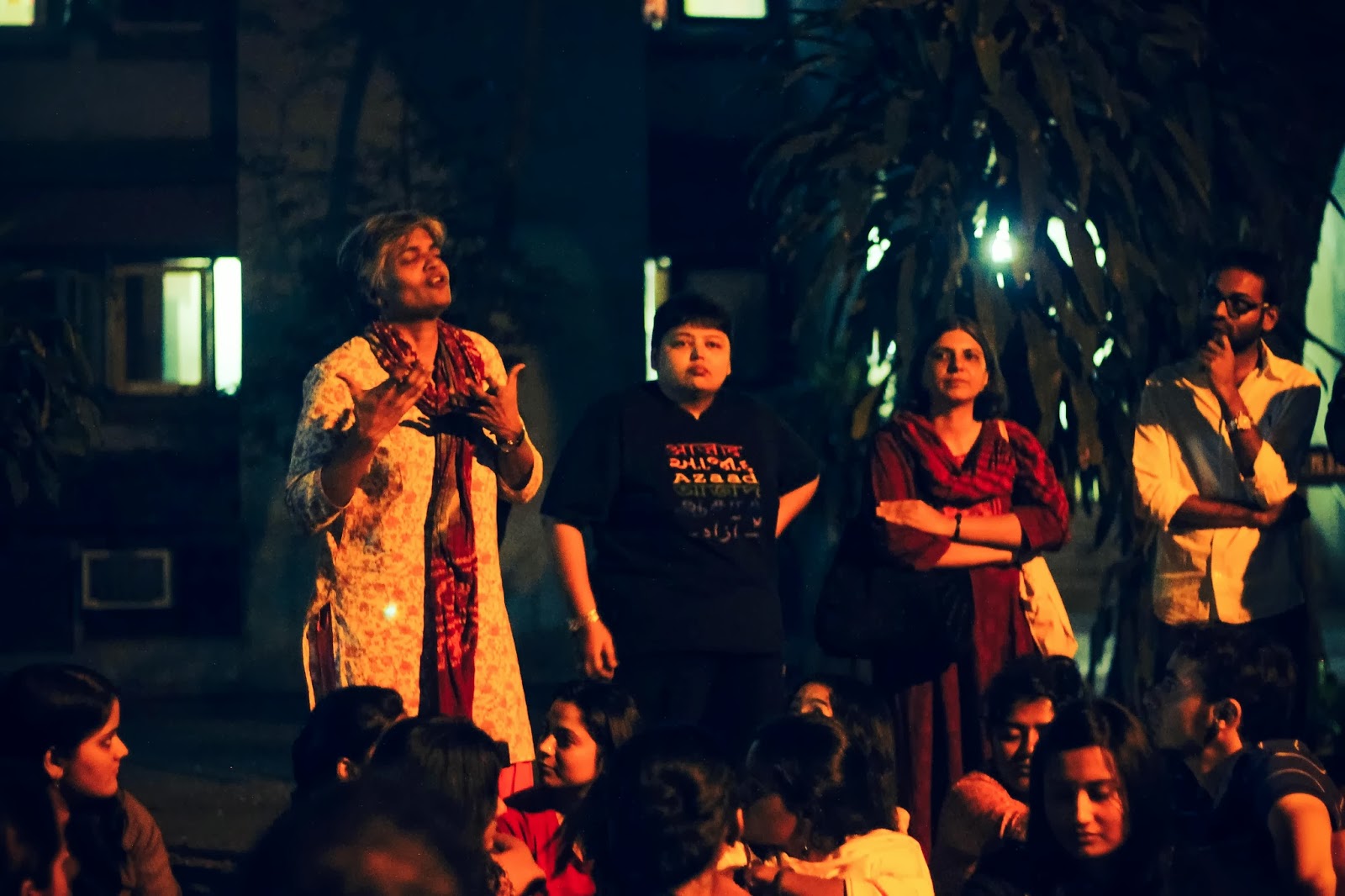
After the outrageous ruling by the supreme court, which criminalised "unnatural sex" (article 377) overturning Delhi high court's ruling in 2009, TISS has been consistently fighting for the rights. The re criminalising of "unnaturalness" (as they claim) is a gross violation of basic human rights, not just for the LGBTQ but for every human in the country.
Some photos of our first gathering near the dining hall in TISS campus


Monday, November 4, 2013

That Halloween Night

Sarppakavu. Photograph via http://www.trekearth.com
I do not keep track of the dates. Everyday is another twenty four hours to me. Be it Sunday or Friday. Which probably explain why I was outside on a Halloween night trying out some photography. I do not believe in Halloween. It has always been something Americans did on certain nights, though India like every other thing, have started copying the western fascination for pumpkin headed ghosts. But the question is, do I believe in ghosts? The super natural. Its a fascinating question, perhaps what pushed me to blogging in the first place was a need to put forward some theories I had about afterlife and multiverse.
Almost all my life, I've spent in the corner of the Ernakulam corporation (Kochi as it is popularly known), once a small town famous for its churches and temples, now for having Kerala's biggest malls all stacked in a kilometre radius. Edappally, the face of the 'metro', also has a history deeply interwoven with rich folk culture and religion.
Edappally Raghavan Pillai and Changampuzha Krishna Pillai, 
often compared to Keats and Shelly for their astounding works in Malayalam literature, come from this little suburb of Cochin. While their life stories, especially their coming together, are known to many in the state of Kerala their personal lives still remain a mystery. Very few know about the death of of Raghavan Pillai's mother. Or his own tragic death, committing suicide at the age of 27 after a love affair with an upper class girl forced him to flee the town. Inside the town, rumour always was that the poet's family had destroyed a 'sarpakavu' (an abode for snakes, especially the sacred cobra) and the curse of the Naga Raja has been with them ever since. Raghavan Pillai's life is filled with tragedies. Changampuzha himself died at a young age of 36 falling prey to Tuberculosis. And there are other stories too about the town. Some not so popular like the tale of the Mozhangumthara family who had no children. It is believed that around 60 dogs lived in that compound, all ferocious, trained to eat children. I still remember having had to jump into their compound to fetch a cricket ball once. Some five dogs had sniffed their way to us right after we climbed the wall. They were not exactly beasts but they still barked like mad. Stories of spirits, yakshis, bison legged men who roam about the streets at midnight.. the stories of the town are endless. 
Why am I saying all this though? Who believes in all these stories in the 21st century? As I was saying in the beginning of the post, I was outside trying to figure out some functions in my camera. But later that night when I was analysing the photos I found out some disturbing patterns. I had put camera on sequence mode and taken some photographs. But the shadow patterns on the tiles were very disturbing. It was different for each photo. 


I am still seeking explanations for the changing shadow patterns. And these are continuous shots. So moon or other sources of light changing positions is out of the question. What caused this sudden change in shadows?
I woke up the next day to see this.


Neighbours car had broken the wall and entered our compound. Strangely at the same place I found the shadows on the previous night.
What do i believe?

Sunday, September 22, 2013

Dear Daughter

Live your life to the fullest my dear,
Go out there and challenge the norms.
Make love, make merry and see the world.
Loiter when the moon is out
And fight them if they ask you why.
They will push you, scare you,
And always discourage you.
But what more can they do?
That they curse you to hell?
But don't you see my little child,
That we already live in one.


Monday, September 2, 2013

A requiem

Life as such is hard at TISS. Day and night they make me work. Periodically filling me with more and more 'duties'. Many times I protested. Squealed, squeaked, coughed out smoke. All to no use.
Last month they 'found' me a partner. Yes, those Kurta wearing social scientists around me who preach about 'choice' and 'love marriage'! But I wasn't complaining. It always feels good to have someone to share things with. Especially work. And my life did become easier for a while. Everyone called us the 'perfect couple'. Spending our days and nights in two separate rooms, serving people - their idea of a honeymoon I suppose. I moved on. What other option did I have anyway? And then it all 'fell apart'. I can't blame him though. Succumbed to the pressure and guilt. Stopped working...
Today I work alone. The night is about to die and I would like to sleep. But people around me are still sending me requests that I cannot say no to. Afterall, that is the purpose of my life - to serve.

These days I dream a lot...
I stand, in the middle of the forest, watching trees fall as I carry on with my work. Animals and birds moving around in panic, while the clouds make way for scorching sunlight. Work, trees, cries, work, trees, cries, work, trees, cries.... silence...
What can I do? I was made to serve. Education has not taught these people. Or has it made them worse? I feel like a hangman at times. Just doing a job. If the world does not care, why should I? In technology I had belief. 'Had'.
I see the boy taking away a lump of 'work' I had just finished for him. I hear cries...
*sigh*

                                                                                            Yours sincerely,
                                                                                            9040 library printer.

Tuesday, August 20, 2013

Analysing Space : Ground floor on TISS Library


Sir Dorabji Tata Memorial library is perhaps the most ‘happening’ space inside the ‘Old Campus’ during the day time. In the ground floor one can witness loud discussions, people with headphones waving at laptops, ‘under the desk’ romance and amidst all that, people genuinely reading. This is perhaps what intrigued and finally convinced me to analyse the same space after midnight.
The reading room can be broadly divided into three sections. The 'couch space' in the eastern corner with glass tables to rest laptops or keep books on. The centre of room has six tables, each with six red chairs around it. And on the western corner are three tables, again with six chairs around it. But the difference is that the chairs are green in colour and the plug points on the table works. It is interesting to note the colour signifiers - the table with red seats does not have electricity supply while the table with green seats have. There are individual reading lights for every table but the hall is well lit that students hardly use it.

Quite contrary to the day time, there are no fights for the ‘green seats’ next to the plug points or corner couches. The book lending section is closed by 8 and it is roped off, so the ground floor is limited to the reading room and the lab for the visually challenged. Most of the chairs were empty but lay at different locations, sometimes quite far away from the desk, constant reminders of the day that had passed.

When I walked in, at the stroke of midnight, there were around twenty five people in the entire room. Two girls sitting on the couch, with their legs on the table, were deep in conversation. It is interesting how the table turns into a space to rest the legs once the crowd has reduced. Very few spaces inside the TISS campus are under surveillance and the library reading room is one such place. The sofa is one place that the camera does not cover and hence one tends to see more intimate conversations there. I do not think its deliberate. It could also well be that the sofa is much better a place for a comfortable talk. Throughout the talk they kept shifting their gaze from their respective laptops, which was placed on their stomachs, to the entrance of the library as if they were expecting someone.
 A student sat on the couch facing the ‘The Speaking Tree’ painting was shuffling vigorously the pages of a book that he had made photocopies of. Another student, who wore a T-shirt which had ‘School of Health System Studies’ written on it and was facing right towards me, had switched on the lamp on the table lamp and was scribbling notes from what seemed like a video of a seminar. During the day the people who are more interested in their work tends to be concentrated around the green table. After midnight they are more scattered as there are more vacant seats and lesser noise.
There were two groups having conversations around the 'red tables'. I could not over hear what they were talking about but from their actions it seemed as if one member in the group was explaining to others about something. I have always been curious as to why groups chose to meet at library ground floor which is a 'reading space', for their discussions. One of the biggest reason should be the lack of such a space inside the college. Apart from the 'quadrangle' and the new campus dining hall, there are no places with uninterrupted internet supply which is open throughout the day. Especially in the evenings, people often choose the library space, because of mosquitoes.
The security guard was asleep on a green chair that had been dragged to a spot next to a pillar where he could rest his head. The reading space is only accessed by the students of TISS. Except for the staff who cleans the tables every day morning, hardly anyone else enters the space. Even the security guards, even if they are upset with something happening inside the space, stands outside and tells. Understandably, they do not like it when the students make noise or switch on the lights next to the space were they sit.
At around one in the night, the majority in the library walks out to the 'SMS' canteen to get a snack before the canteen closes. The return back at different times, some don't, but generally, I noticed that everyone are back with an hour. After they return, some people move to the cyber library on the first floor. By then the staff in the cyber lab, who wouldn't otherwise allow laptops inside, would've have left. The lab is often more quieter and the air conditioned, so many prefer the place for getting the work done.
One thing that can be noticed about everyone in the ground floor (excluding the security guards) is the way they have all chosen to wear comfortable dresses. Most of them are dressed like how one would be inside in one's own house and that reflected how comfortable people were in that space. One of the student I talked to even had his tooth brush and paste with him. With filtered water also available, for many the ground floor was equivalent to their home.

The night was pretty dull and there were hardly anything that made you look at someone or something. The people inside kept moving in and out, mostly for a small walk or to attend phone calls. Students from the cyber library kept going out but nobody wanted to use the space in the ground floor. By around three, only one person had left. Surprisingly everyone had maintained their levels of intensity in whatever they were doing.  

The only incident worth mentioning, was my brief conversation with the security guard sitting outside the library. He had woken up by the sound I made while entering the library after a brief stroll and could not come to terms with the fact that I was a student. ID card and persuasion convinced him to finally allow me to enter.

The whole night was a huge contrast to the day time where there is life bustling in every corner. It is very difficult to come to a conclusion as to what type of people who generally visits people. One can safely assume it gets more crowded on during the exams. Most of the remaining group left by 4:00 a.m and the one person who was remaining lived in a house outside the campus.
My observation and analysis of the space is in no way complete or comprehensive. It is not exactly the same group that visits the library every day. What one can safely assume about the ground floor in the library is the fact that it is much beyond a reading space. It is where people like to meet up and discuss things. Silence is next to absent in the hall and there are hardly any boards/signs asking the students to keep quiet. The saddest part is how the library is no longer very reader friendly.


View My Stats
Twitter Delicious Facebook Digg Stumbleupon Favorites More

 
Design by Free WordPress Themes | Bloggerized by Lasantha - Premium Blogger Themes | coupon codes